
Health Minister commends the WHO report on the Egyptian case study and its success in eliminating Virus C..

Health Minister commends the WHO report on the Egyptian case study and its success in eliminating Virus C..
Health Ministry: The report identified 5 key elements that contributed to the success of the Egyptian programme in eliminating the virus..
Health Ministry: The elements cited by the Organization included political commitment to increased spending on health care and strong infrastructure...
=============
Dr. Khaled Abdel Ghaffar, Minister of Health and Population, commended the World Health Organization's 2024 report on the Egyptian case study and its success in eliminating Virus C within the framework of achieving the Sustainable Development Goals.
Dr. Hossam Abdel Ghaffar, the official spokesperson of the Ministry of Health and Population, said that the report
pointed out that 5 key elements contributed to the success of Egypt's programme to eliminate Virus C: the availability of sufficient and reliable epidemiological data; a strong public health care infrastructure; comprehensive care reaching all sectors of society; political commitment to increased spending on health care; and the development of a comprehensive long-term strategy to combat viral hepatitis and the use of innovation and information technology.
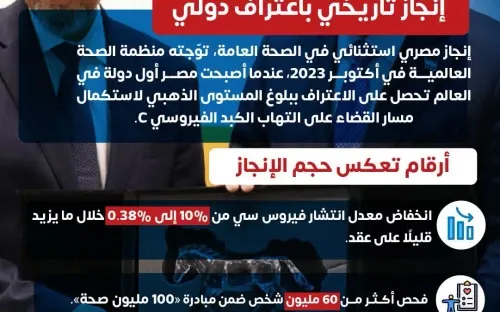
"Abdel Ghaffar" added that the report explained that in 2023 Egypt became the first country to achieve gold tier status in eliminating hepatitis C, according to World Health Organization criteria, by implementing one of the largest hepatitis screening and treatment programmes in the field of public health.
He continued that the report confirmed that Egypt has achieved the World Health Organization's targets, which will prepare the country to achieve reductions in infection and mortality rates amounting to the complete elimination of the disease before 2030, as Egypt had one of the highest rates of viral hepatitis infection in the world between the 1950s and the 1980s.
"Abdel Ghaffar" said that the report stated that since the early 1990s the government has made a great effort to strengthen hepatitis prevention, through programmes covering blood safety, infection control and injection safety, and has also worked to raise public awareness and implement risk-reduction programmes.
"Abdel Ghaffar" added that the report noted that Egypt launched a network of specialised treatment centres in 2006, and with the discovery of new antiviral drugs in 2014, hepatitis testing and treatment became available to all free of charge. In 2018, the government launched the presidential initiative "100 Million Healthy Lives", a massive and unprecedented nationwide campaign to detect and treat all people infected with hepatitis C and to scale up elimination efforts. The campaign targeted all people over 18 years of age, and was later expanded to include children aged 12 and above.
"Abdel Ghaffar" pointed out that the report highlighted routine testing in all health facilities in Egypt, as well as community awareness campaigns, which spread to large squares, markets, workplaces, sports clubs, mosques, churches and barber shops. The campaign also included non-Egyptians residing in Egypt.
He continued that the report explained that between 2018 and 2022 more than 60 million people were screened using rapid diagnostic tests approved by the World Health Organization; patients were also assessed and treated for other chronic diseases, such as hypertension and diabetes; and treatment was provided to 4.1 million people with Virus C, using locally manufactured drugs, between 2014 and 2022.
"Abdel Ghaffar" explained that the report pointed to the expansion of direct public health approaches for community prevention, testing and treatment in Egypt, and showcased Egypt's successful public health programme to eliminate hepatitis C, which can have a positive impact on the entire population.