
Following Cabinet approval.. Minister of Health announces the Ministry's plan for dealing with cases of sudden cardiac arrest
Dr. Khaled Abdel Ghaffar, Minister of Health and Population, affirmed the Egyptian state's keenness and constant attention to preserving the health and safety of citizens, and its continuous work to achieve health security for Egyptian citizens, whether at the medical, awareness or research level.
Dr. Khaled Abdel Ghaffar thanked Prime Minister Dr. Mostafa Madbouly for approving the results of the study conducted by the Ministry of Health and Population on the proposal for dealing with cases of sudden cardiac arrest through the deployment of cardiac defibrillators, and its executive mechanisms.
Dr. Hossam Abdel Ghaffar, official spokesperson of the Ministry of Health and Population, explained that sudden cardiac arrest often occurs when a disturbance in the heart's electrical activity causes the heart to beat dangerously fast, ventricular tachycardia, or due to rapid irregular heartbeats (ventricular fibrillation), explaining that irregular heartbeats prevent the heart from pumping blood efficiently, which causes cardiac arrest, followed by a lack of blood flow to the brain for 3 to 4 minutes, and death occurs if cardiac arrest lasts for more than minutes.
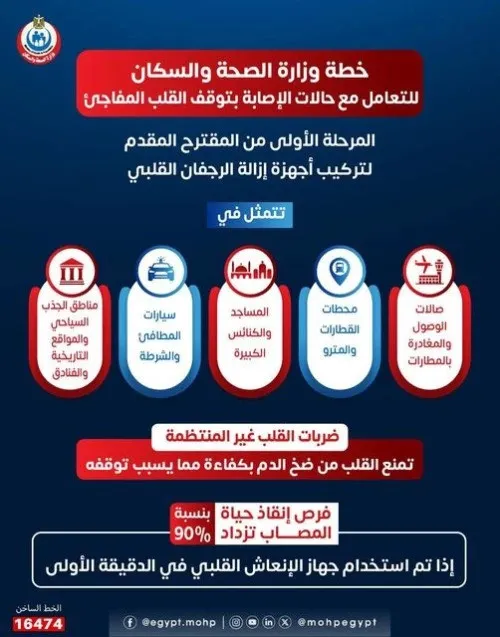
Abdel Ghaffar affirmed that the chances of saving the life of a person suffering sudden cardiac arrest increase by 90% if a cardiac resuscitation device is used within the first minute, and the rate decreases by 10% for every minute without intervention.
Abdel Ghaffar added that sudden cardiac arrest causes about 14% of the deaths that occur annually in Egypt, while the number of deaths from sudden cardiac arrest outside hospitals in the United States of America reaches 360,000 cases annually.
Abdel Ghaffar noted that the Ministry of Health's proposal to install cardiac defibrillators comes in 3 phases, the first being the priority phase, which covers arrival and departure halls at airports, train and metro stations, large mosques and churches, fire and police vehicles, tourist attractions, historical sites and hotels.