
Ministry of Health: more than 575 thousand newborns screened under the President's Initiative for Early Detection of Genetic Diseases in Newborns
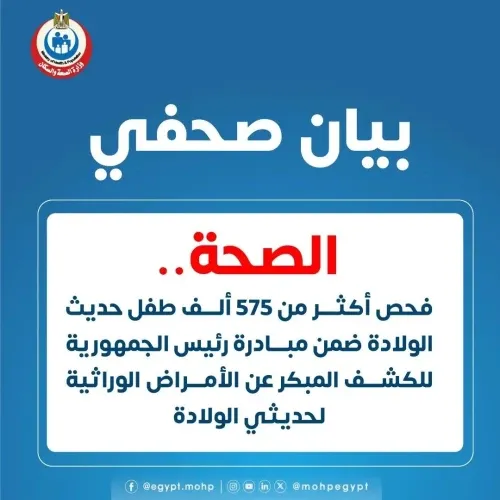
Ministry of Health: more than 575 thousand newborns screened under the President's Initiative for Early Detection of Genetic Diseases in Newborns
Ministry of Health: centers for the treatment of genetic diseases in newborns increased to 56
The Ministry of Health and Population announced that the number of centers specialized in treating genetic diseases in newborns has increased to 56, in cooperation with the Supreme Council of University Hospitals, affiliated with the Ministry of Higher Education and Scientific Research, as part of the President's Initiative for the Early Detection of Genetic Diseases in Newborns, under the slogan "100 Million Healthy Lives".
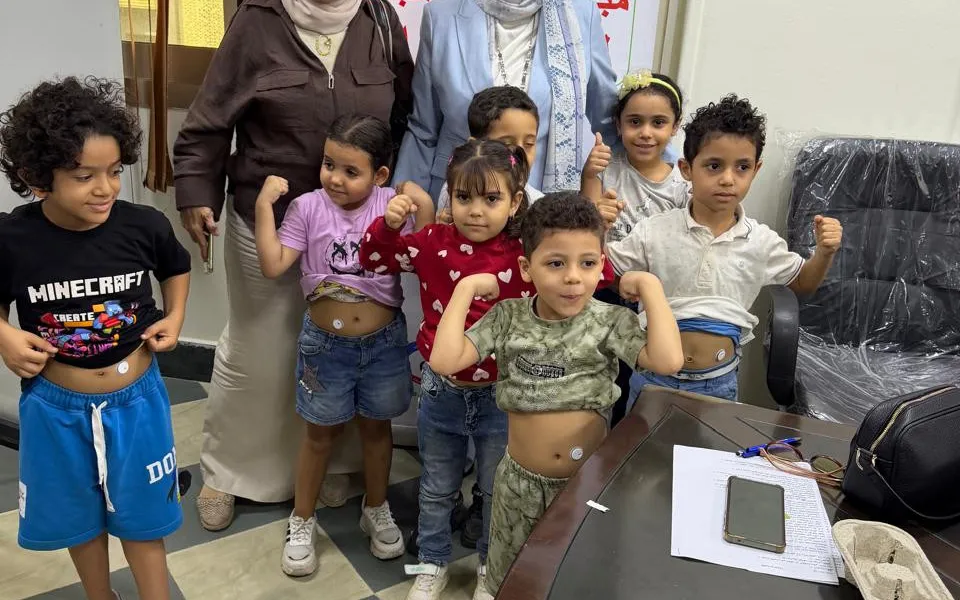
Dr. Hossam Abdel Ghaffar, the official spokesperson of the Ministry of Health and Population, affirmed that the centers are being progressively expanded to cover all governorates, providing free treatment and periodic follow-up services for children suffering from any genetic diseases. He noted that 575,431 newborns have been screened under the initiative since its launch on 13 July 2021 until today, with the aim of achieving a healthy generation free of the causes of disability.
Abdel Ghaffar pointed out that the first phase of the initiative aims to detect 19 genetic diseases in premature infants in the incubators of Ministry of Health and Population hospitals, and the second phase of the initiative is set to include medical screening for all newborns in all health units nationwide.
For her part, Dr. Rasha Khedr, Head of the Primary Care and Family Development Sector, explained that the 19 diseases screened for include (congenital hypothyroidism, congenital adrenal hyperplasia, favism (G6PD deficiency), cystic fibrosis, familial hyperlipidemia, phenylketonuria, tetrahydrobiopterin deficiency, organic acidemias, isovaleric acidemia, propionic/methylmalonic acidemia, maple syrup urine disease, tyrosinemia type I, galactosemia, homocystinuria, argininemia, citrullinemia, ornithine transcarbamylase deficiency, fatty acid oxidation disorders, and biotinidase deficiency).
Dr. Rasha Khedr stressed that the screening is carried out by taking a blood sample from the baby's heel and analyzing it in the laboratories of the Egyptian Center for Disease Control "Egyptian CDC", which are equipped with the latest devices for detecting genetic diseases. She explained that if the sample is positive, the child is referred for a confirmatory test and starts receiving the necessary treatment "free of charge" according to the protocols set by the initiative's scientific committee.
For her part, Dr. Nanis Abdel Mohsen, Coordinator of the Initiative for Early Detection of Genetic Diseases, noted that the 56 centers are distributed across the governorates as follows: (the Metabolic Diseases Clinic at the University Hospital, and the Genetic Counseling Clinic at Misr El Hora Hospital) in Minya Governorate; (the Nutrition and Gastroenterology Clinic at Assiut University Children's Hospital, the Genetic Counseling Center, and Al-Iman Hospital in Al-Arbaeen District) in Assiut Governorate; (the Metabolic Diseases Clinic at Sohag University Hospital, and Gezirat Mahrous Medical Center) in Sohag Governorate; (the Genetic Counseling Clinic at El Raml Children's Hospital, the Students' Hospital in Sporting, the Clinical Genetics Center at Smouha Hospital, the Ketogenic Diet Clinic at Smouha Hospital, and the Metabolic Diseases Clinic at Smouha Hospital) in Alexandria Governorate; (the Ketogenic Diet Clinic at the National Research Centre, the Pediatrics Clinic at the National Research Centre, and the Sheikh Zayed Medical Center) in Giza Governorate; (Old Cairo Child Care Center, New Nozha Medical Center, Rod El Farag Medical Center, Ain Helwan Medical Center, the Genetics Clinic at El Demerdash Children's Hospital, the Ketogenic Nutrition Clinic at El Demerdash Hospital, the Gastroenterology Clinic at El Demerdash Children's Hospital, the Nephrology Clinic at Abu El Reesh El Mounira Hospital, Abu El Reesh Japanese Hospital, the Gastroenterology and Hepatology Clinic at Abu El Reesh Specialized Hospital, and the Nutrition Clinic at Abu El Reesh Hospital) in Cairo Governorate; (the Metabolic Diseases Clinic at Zagazig University Children's Hospital, and the health unit in Shershima village) in Sharqia Governorate; (the Metabolic Diseases Clinic at Shebin El Kom University Hospital, the Pediatric Gastroenterology Clinic at the Liver Institute, and Shebin El Kom Health Center) in Menoufia Governorate; (the Gastroenterology Clinic at the University Children's Hospital) in Ismailia Governorate; (Talkha Child Care, Meet Sandoub Medical Center, and Mansoura University Children's Hospital) in Dakahlia Governorate; (Tanta General Medical Center, the Genetics Unit at Tanta University Hospital, and the Gastroenterology Unit at Tanta University Hospital) in Gharbia Governorate; (El Nafaq Medical Center, and the Genetic Counseling Center at El Qanadla Medical Center) in Aswan Governorate; (the Genetic Counseling Center) in Qena Governorate; (the Genetic Counseling Center in Kiman Fares) in Fayoum Governorate; (the Third District Medical Center in Damietta) in Damietta Governorate; (the Genetic Counseling Center at Al-Arab Specialized Medical Complex) in Port Said Governorate; (El Helal Child Care in Damanhour, and Dimisna General Hospital) in Beheira Governorate; (the Therapeutic Nutrition Clinic at the University Children's Hospital, and East Beni Suef Medical Center) in Beni Suef Governorate; (the Specialized Children's Hospital) in Qalyubia Governorate; (Matrouh General Hospital) in Matrouh Governorate; (Hurghada Fever Hospital) in Red Sea Governorate; (Old Karnak Unit) in Luxor Governorate; (Kharga Child Care) in New Valley Governorate; (Kafr El Sheikh University Hospital) in Kafr El Sheikh Governorate; (the Genetic Counseling Center) in Suez Governorate; and (the Genetic Counseling Center at El Arish General Hospital) in North Sinai Governorate.